In a dim, forgotten basement in São Paulo, Brazil, a discovery unfolded that revealed both the harsh reality some animals endure and the extraordinary strength that can still survive beneath layers of suffering. In that dark, airless space, rescuers found a bulldog whose life had been shaped entirely by hardship. Her body was frail, her spirit nearly silent, yet there remained a small spark inside her that refused to disappear.
She would later be given the name Grace—a name that, with time, came to reflect the quiet courage that carried her through her darkest chapter.
Grace was found during a police raid on an illegal breeding operation, a place where animals were kept in deeply improper conditions and valued only for profit. She had spent nearly her entire life trapped in that underground room, hidden from sunlight, companionship, and any sense of comfort. To her captors, she existed only to produce litter after litter, without rest, without kindness, and without the basic care every living being deserves.
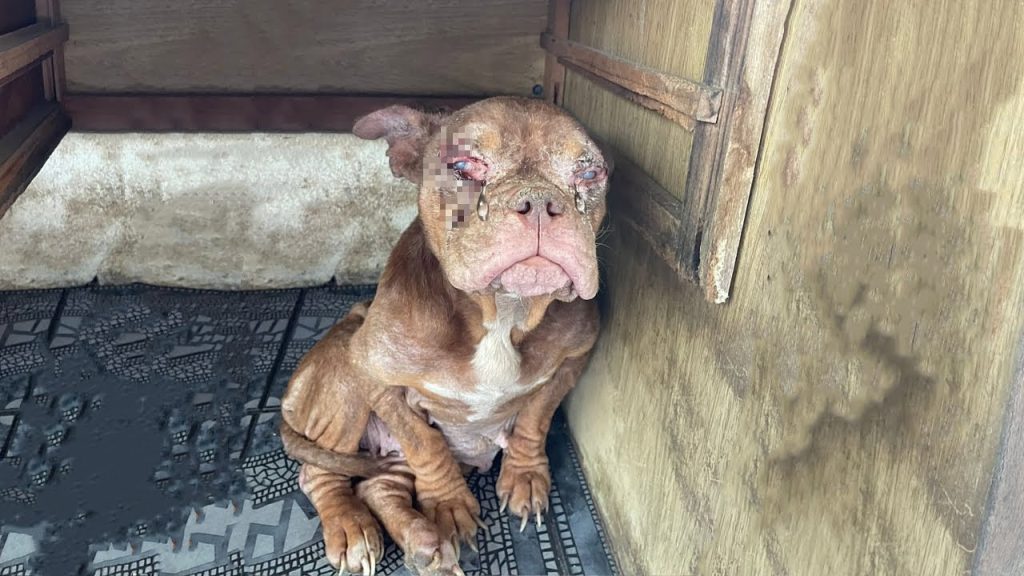
When rescuers reached her, the scene was heartbreaking. Grace was so thin her ribs pressed clearly against her skin. Her eyes were swollen from infection, leaving her barely able to see. Her coat was rough and cracked, marked by untreated skin problems and painful sores. Her breathing was strained, and yet when a gentle hand reached toward her, she didn’t retreat or show fear. Instead, she leaned forward, as if recognizing the difference between cruelty and compassion.
That single moment—the soft touch of someone who truly meant her no harm—became the beginning of her second chance. But the road ahead would not be simple.
She was rushed immediately to a veterinary clinic, where a dedicated team worked urgently to stabilize her. Grace’s condition was fragile, and every minute mattered. During her initial examination, an ultrasound revealed a heartbreaking truth: she was carrying a fetus without a heartbeat. The room fell silent as the weight of that discovery settled on everyone present. It was not only her physical suffering that struck them—it was the emotional toll etched into her expression, the evidence of years without care or comfort.

One rescuer, visibly shaken, chose not to leave her side. He whispered soothing words, gently stroked her head, and reassured her that the worst was now behind her. Exhausted as she was, Grace responded with the faintest wag of her tail and a small, hesitant lick of his hand. That simple gesture—a fragile sign of trust from a dog who had every reason to fear humans—felt nothing short of miraculous.
Her recovery began with patience, medical treatment, and an environment centered on compassion. Veterinarians administered antibiotics to control her infections and medications to stabilize her system. She was given a warm, gentle bath to cleanse her skin and ease months—perhaps years—of discomfort. Every step of her treatment was carried out with care, never rushed, always mindful of the trauma she had endured.
In the days that followed, Grace began a transformation that astonished everyone involved. Though her vision remained limited, she showed greater awareness of the world around her. She responded to voices, especially the familiar, reassuring tone of the rescuer who had stayed with her. Their bond deepened quickly as she learned, moment by moment, that she was finally safe. She began approaching him with more confidence, and the first time she rested her head fully in his palm, it felt like witnessing hope return after a very long absence.
After two weeks of intensive treatment and constant attention, Grace was healthy enough to leave the clinic. The man who had watched over her brought her to his shelter, Pits’ Alex, a haven for dogs who had endured similarly difficult pasts. There, Grace finally experienced what life should have offered her from the beginning—open spaces, sunlight, a soft place to sleep, and most importantly, unconditional kindness.
He describes her as a deeply sensitive soul—gentle, affectionate, and eager to connect. Grace does not merely seek love; she gives it freely now, offering soft glances, warm nuzzles, and a tail that wags with gratitude rather than fear. She holds no resentment, seeks no revenge, and carries no bitterness. Instead, she reflects a quiet forgiveness that reminds everyone around her of the remarkable resilience found in animals. Her spirit shows that even after deep suffering, healing becomes possible when compassion is given room to grow.

Grace’s story is a powerful reminder of why it is essential to stand against cruelty, support ethical rescue organizations, and remain aware of the silent suffering that too often goes unseen. But her journey is also a story of hope—because she survived, because someone cared enough to intervene, and because today Grace is far more than a survivor. She has become a symbol of strength and renewal.
Every time she rests her head in a warm lap or trots through the grass at the shelter, she reclaims a piece of the life that was stolen from her. And every time she looks up at the man who saved her, with soft eyes full of trust, she reminds us all that even after the darkest experiences, kindness can still take root and flourish.
In a world that can often feel heavy, Grace stands as a gentle, unwavering light. And now, at long last, she is truly home.